🚀 Building Smarter AI: A Complete Guide to RAG Chatbots
Introduction
Traditional AI chatbots often struggle with outdated knowledge, irrelevant answers, and hallucinations. As businesses demand more accurate and real-time responses, a new approach has emerged — Retrieval-Augmented Generation (RAG).
RAG enhances chatbot intelligence by combining Large Language Models (LLMs) with real-time data retrieval, making responses more accurate, relevant, and trustworthy.
🤖 What is a Conversational AI Chatbot?
A conversational AI chatbot is a system that can interact with users using natural language.
It is powered by:
- Natural Language Processing (NLP) → Understands human language
- Machine Learning (ML) → Learns patterns and improves over time
These chatbots are widely used in:
- Customer support
- Virtual assistants
- Education platforms
However, traditional chatbots rely heavily on pre-trained data, which becomes outdated quickly. :contentReference[oaicite:0]{index=0}
⚠️ The Problem with Traditional Chatbots
Even advanced AI models face key challenges:
- ❌ Outdated Knowledge – Models don’t know recent data
- ❌ Hallucinations – Generate incorrect or fabricated answers
- ❌ Lack of Context – Cannot access company-specific data
- ❌ Limited Personalization
This is where RAG changes the game.
🔍 What is RAG (Retrieval-Augmented Generation)?
RAG is an AI architecture that combines:
- Retrieval System → Fetches relevant data from external sources
- Generation Model (LLM) → Generates responses using that data
Instead of relying only on training data, RAG dynamically injects fresh, trusted information into the response generation process. :contentReference[oaicite:1]{index=1}
⚙️ How RAG Chatbots Work
Here’s a simplified flow:
- User asks a question
- System searches relevant data (documents, databases, APIs)
- Retrieved data is added to the prompt
- LLM generates a response using both:
- Pre-trained knowledge
- Retrieved real-time data
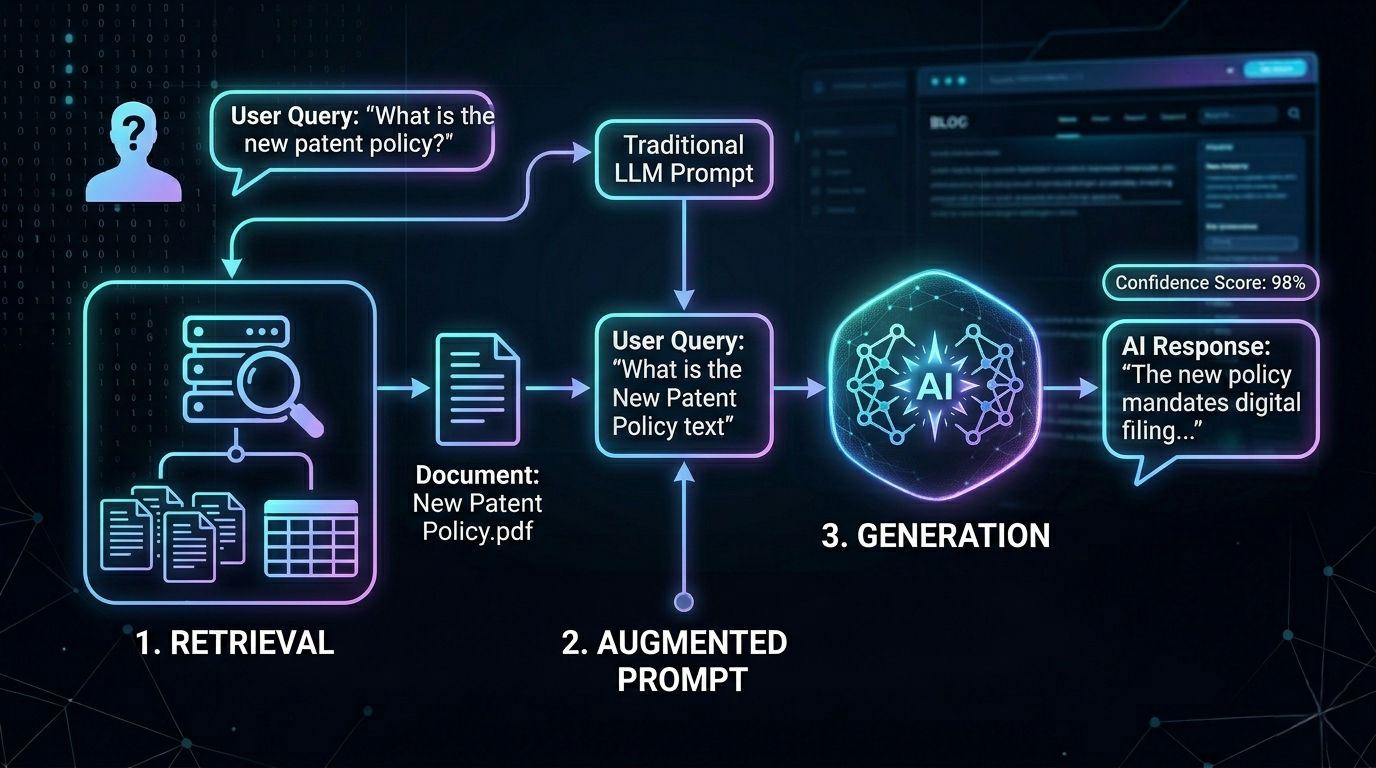
👉 Result: More accurate and context-aware answers
💡 Key Benefits of RAG Chatbots
1. 🕒 Real-Time Knowledge
RAG allows chatbots to access live and up-to-date data, solving the stale data problem.
2. 🎯 Improved Relevance
Responses are grounded in actual data, making them more context-aware and precise.
3. 💪 Better Accuracy & Robustness
RAG reduces hallucinations and improves confidence when handling complex queries. :contentReference[oaicite:2]{index=2}
4. 🔐 Enterprise Data Integration
RAG can connect with:
- CRM systems
- Databases
- Internal knowledge bases
🏢 Real-World Use Cases
📞 Customer Support
- Access past tickets and CRM data
- Provide instant, accurate answers
🎓 Education
- Personalized tutoring based on student data
🏥 Healthcare
- Retrieve latest medical knowledge
- Provide evidence-based responses
💼 Enterprise AI Assistants
- Query internal systems like ERP, HR, or finance tools
🧠 Why RAG is Critical for Modern AI
LLMs alone are powerful but limited:
- They are static after training
- They lack access to private data
RAG solves this by:
- Bridging the gap between AI models and real-world data
- Enabling context-aware intelligence
- Making AI production-ready for enterprises
🏗️ RAG Architecture (High-Level)
A typical RAG system includes:
- Data Sources → Documents, APIs, databases
- Retriever → Finds relevant information
- Vector Database → Stores embeddings
- LLM → Generates final response
.png)
Some advanced systems also:
- Combine structured + unstructured data
- Apply security and access controls
- Use semantic layers for better context
📊 Adoption Trends
RAG adoption is rapidly growing:
- 12% → Already in production
- 60% → Piloting
- 24% → Planning
- 4% → Exploring :contentReference[oaicite:3]{index=3}
👉 This shows RAG is becoming a standard for enterprise AI systems.
⚡ Challenges in RAG Systems
Despite its advantages, RAG has challenges:
- Data quality impacts accuracy
- Poor retrieval = poor responses
- Scaling retrieval systems efficiently
- Maintaining security and governance
🔮 The Future of RAG Chatbots
RAG is evolving into:
- Hybrid retrieval systems (structured + unstructured data)
- Real-time enterprise AI assistants
- Highly personalized AI experiences
Future systems will focus on:
- Faster retrieval
- Better context understanding
- Stronger evaluation frameworks
🏁 Conclusion
RAG is transforming chatbots from generic responders into intelligent, data-driven assistants.
By combining:
- The reasoning power of LLMs
- The accuracy of real-time data
👉 RAG enables AI systems that are:
- More reliable
- More relevant
- Ready for real-world applications
✨ TL;DR
- Traditional chatbots = static + error-prone
- RAG chatbots = dynamic + accurate
- Future AI systems will rely heavily on RAG