🤖 Build a Self-Optimizing AI Agent That Continuously Learns From Feedback
🔥 Introduction
What if your AI agent didn’t just respond—but evolved with every interaction?
Imagine an intelligent system that learns from its mistakes, adapts to user behavior, and improves performance over time—without constant retraining.
Most AI systems today are static and predictable. But in this guide, you'll discover how to build a self-optimizing AI agent powered by:
- Reinforcement Learning (RL)
- Retrieval-Augmented Generation (RAG)
- Real-time feedback loops
- Dynamic skill memory
By the end, you'll have a clear blueprint to create AI systems that continuously learn, refine, and outperform themselves.
❌ Why Traditional AI Agents Fall Short
Most AI assistants follow a rigid pipeline:
- User submits a query
- AI generates a response
- Interaction ends
That’s it—no learning, no adaptation, no growth.
🚫 Key Limitations:
- Repeated errors across sessions
- Generic, non-personalized responses
- Zero improvement over time
Even after hundreds of interactions, the system remains fundamentally unchanged.
🧠 The Breakthrough: Self-Improving AI Systems
Human learning follows a powerful loop:
Act → Receive Feedback → Adjust → Improve
We can replicate this intelligence in AI using:
- Reinforcement Learning (RL): Optimize decisions using reward signals
- RAG (Retrieval-Augmented Generation): Inject real-time knowledge
- Feedback Mechanisms: Learn directly from users
- Skill Memory Systems: Store and reuse successful strategies
This creates a closed-loop learning system where improvement is continuous and automatic.
.png?updatedAt=1774465123717)
🏗️ Architecture of a Self-Learning AI Agent
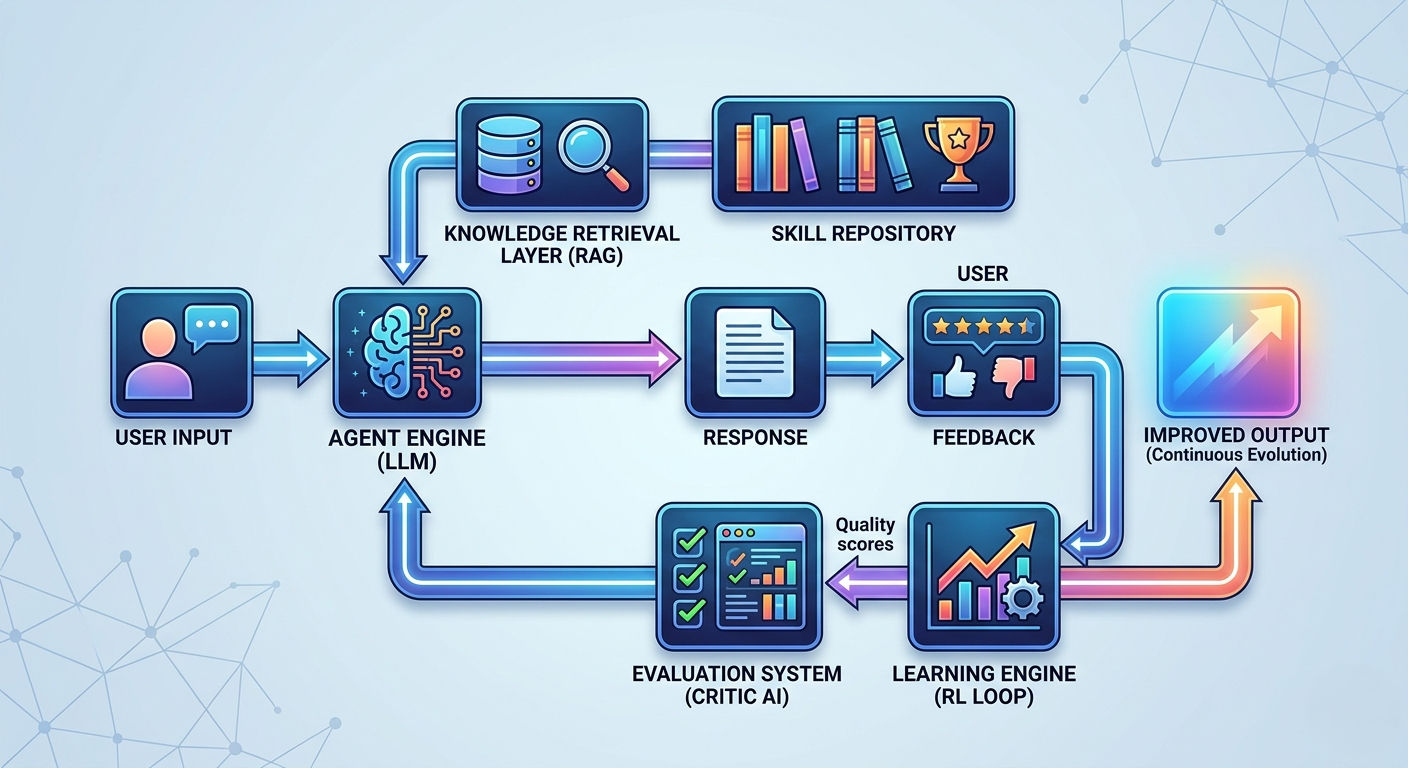
🧩 Core Components:
- Agent Engine – Handles reasoning and response generation
- Knowledge Retrieval Layer (RAG) – Fetches relevant context dynamically
- Skill Repository – Stores high-performing strategies
- Learning Engine (RL Loop) – Optimizes based on rewards
- Evaluation System (Critic AI) – Scores and refines outputs
Together, these components form a self-evolving AI ecosystem.
🧠 Skill Memory: The Competitive Advantage
Instead of retraining models repeatedly, we introduce Skill Memory.
💡 What is a Skill?
A skill represents a proven, high-performing strategy, including:
- Context-aware reasoning patterns
- Structured response templates
- Problem-solving approaches
📊 Each Skill Tracks:
- Description
- Context of use
- Performance score
- Frequency of success
⚙️ How It Works:
- The agent retrieves relevant skills before generating responses
- Applies the most effective strategies
- Updates performance scores after feedback
👉 Over time, your AI builds a high-value intelligence library of winning behaviors
⚙️ Reinforcement Learning Loop (The Core Engine)
Every interaction feeds into a reward-driven optimization system.
🎯 Reward Factors:
- Task completion success
- Response accuracy and quality
- Efficiency and latency
- User satisfaction score
📈 Reward Formula:
Reward Score = (Success + Quality + Efficiency + User Feedback) / 4This score continuously fine-tunes the agent’s decision-making and skill prioritization.
🔁 Feedback Loop: Continuous Intelligence Upgrade
The feedback loop is what transforms your AI from static to adaptive:
- User submits a query
- AI generates a response
- User provides feedback (ratings, signals)
- System converts feedback into reward signals
- Skills are updated and re-ranked
- Future responses improve automatically
🔄 This loop ensures your AI becomes smarter with every interaction
🤖 Critic AI: Automated Evaluation at Scale
To accelerate improvement, introduce a Critic AI system.
🧠 What It Does:
- Evaluates responses in real time
- Assigns quality scores (0–1 scale)
- Provides consistent, unbiased feedback
📊 Evaluation Metrics:
- Accuracy
- Relevance
- Completeness
- Clarity
This enables continuous learning—even without human input.
🧱 Recommended Tech Stack
For a production-ready system:
- Backend: FastAPI
- Agent Framework: LangChain / Agno
- Vector Database: LanceDB / Pinecone
- Frontend: React / Next.js
- LLMs: OpenAI / Claude
This stack supports scalable, feedback-driven AI systems.
🔄 Why Self-Improving AI Matters
Traditional AI:
- Static outputs
- No memory
- One-time responses
Self-Optimizing AI:
- Continuous learning
- Adaptive intelligence
- Personalized experiences
This aligns with cutting-edge techniques like Reinforcement Learning from Human Feedback (RLHF)—the backbone of modern AI systems.
⚠️ Challenges to Consider
Building self-improving AI comes with complexity:
- ⚠️ Poor feedback can degrade performance
- ⚠️ Risk of reward manipulation
- ⚠️ Increased system design complexity
- ⚠️ Requires robust evaluation pipelines
Success depends on high-quality feedback and strong system design.
💡 Expert Tips for Building Smarter AI
- Start with focused use cases
- Combine human + AI feedback systems
- Continuously track performance metrics
- Avoid overfitting to biased feedback
- Iterate and refine your learning loop
🚀 Final Thoughts
We are entering a new era of AI:
Static Systems → Adaptive Systems → Self-Optimizing Intelligence
The future belongs to AI that doesn’t just respond—but learns, evolves, and improves autonomously.
Build it right, and your AI won’t just serve users…
It will continuously outperform its previous version.