DeepAgents: Mastering Autonomous Workflows with the Harness Framework by LangChain
In AI development, the shift from static prompts to autonomous agents is the next big step. Teams want more than simple chatbots. They need systems that can reason, plan, and execute multi-step jobs.
Enter DeepAgents, a framework built on LangChain. It helps developers build, manage, and deploy autonomous agents in production environments.
Today, the core engineering question has changed. It is no longer just: "How do I prompt an LLM?" Instead, engineers ask: "How do I run a reliable agent without constant supervision?" DeepAgents provides a structured "harness." This harness keeps non-deterministic models aligned, observable, and safe.
1. The Evolution of Agentic Workflows
To see the value of DeepAgents, consider where standard workflows fall short.
From Linear Chains to Dynamic Reasoners
Early pipelines chained prompt steps in a rigid line: step A led to step B, then to step C. This pattern fails under real-world conditions:
- Fragile Flows: If one step returns bad data, the entire chain stops.
- No Self-Correction: Static chains cannot inspect errors or try alternative strategies.
Agents change how work gets done. An agent uses a foundation model as a reasoning engine. It dynamically decides:
- Which tools to invoke.
- What arguments to send.
- How to check results before taking the next step.
The "Harness" Philosophy
Pure autonomy can lead to unpredictable behavior. This is why DeepAgents introduces an execution Harness.
Think of the Harness as your agent's control plane. It wraps the model and tools together. It enforces guardrails, saves state checkpoints, handles retries, and collects telemetry. With this harness, an unpredictable model becomes a stable software component that fits into enterprise CI/CD pipelines.
2. Core Architecture of DeepAgents
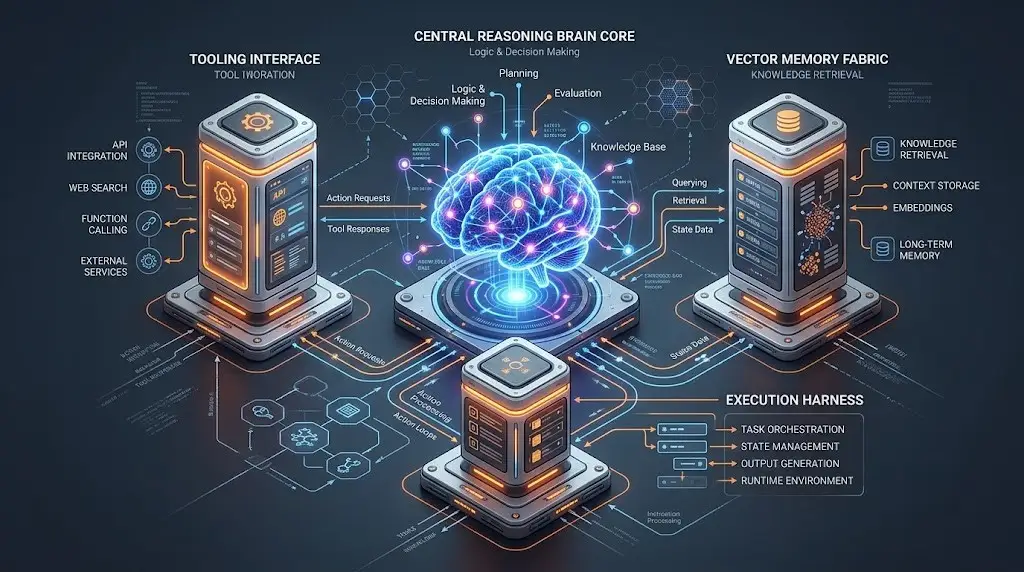
DeepAgents organizes system logic into three core pillars: Reasoning, Tooling, and Memory.
The Reasoning Core (The Brain)
Every agent centers on a planning engine. DeepAgents applies the ReAct (Reasoning + Acting) pattern. Before running an action, the agent writes out its thoughts and plans. This step cuts down hallucinations and avoids missed edge cases.
The Tooling Interface (The Hands)
An agent is only as good as the tools it can reach. DeepAgents integrates Pydantic schema validation for Python functions, REST endpoints, and SQL queries. This catches bad arguments before they hit your external services.
The Memory Fabric (The Context)
Context management is split into three layers:
- Short-Term Memory: Tracks current conversation turns.
- Working Scratchpad: Stores tool outputs and active reasoning loops.
- Long-Term Retrieval: Uses vector stores like Pinecone or Chroma to fetch relevant documents and user history on demand.
3. Hands-On: Building Your First DeepAgent
Setting up an agent with DeepAgents takes only a few steps.
Step 1: Environment Setup
Install the necessary libraries into your virtual environment:
pip install langchain langchain-openai deepagents-coreStep 2: Defining Custom Tools
Wrap your application logic using standard typing and clear docstrings:
from langchain.tools import tool

@tool
def get_customer_status(customer_id: str) -> str:
    """Retrieve the subscription tier and account status for a given customer ID."""
    database = {
        "12345": {"tier": "Pro", "status": "Active"},
        "67890": {"tier": "Free", "status": "Active"}
    }
    customer = database.get(customer_id, {"tier": "Unknown", "status": "Not Found"})
    return f"Customer {customer_id} is on the '{customer['tier']}' tier (Status: {customer['status']})."
Step 3: Initializing the Harness
Configure your model, attach tools, and set clear system constraints:
from deepagents import AgentHarness

# Initialize the agent harness with explicit operational rules
harness = AgentHarness(
    model="gpt-4o",
    tools=[get_customer_status],
    system_prompt=(
        "You are an enterprise support assistant. "
        "Always query the customer database to verify account tier and status "
        "before suggesting upgrades or modifications."
    )
)

# Run an autonomous query
response = harness.run("Can you check the current status for user 12345 and see if they qualify for Enterprise?")
print(response)
4. Advanced Guardrails and Observability
Production workloads require strong supervision and audit trails. DeepAgents handles this through lifecycle hooks and telemetry.
Pre- and Post-Execution Guardrails
DeepAgents uses lifecycle hooks to protect your system:
- Pre-Execution Checks: The harness inspects tool arguments first. If it detects a risky operation, it stops execution or requests Human-in-the-Loop (HITL) approval.
- Post-Execution Filters: The harness inspects outputs to mask private data and API keys before sending them back to the model.
Observability with LangSmith
DeepAgents links directly with LangSmith to trace execution. Every run records:
- Step-by-step reasoning logs.
- Full payloads for all tool calls.
- Token latency, execution costs, and system bottlenecks.
5. Architectural Best Practices
Keep these core principles in mind when building agents:
- Keep Tools Atomic: Build small, single-purpose tools. Narrow tools help models pick the right actions without confusion.
- Return Clear Errors: Never hide failures. Return descriptive error messages so the model can adjust its strategy.
- Set Execution Limits: Always set step counts and timeouts. This prevents runaway loops and unexpected token usage.
- Use Staged Autonomy: Require human confirmations for write actions first. Grant full automation only after your evaluations pass benchmark tests.
The Road Ahead
DeepAgents is expanding into hierarchical multi-agent architectures. In this model, specialized agents for research, coding, and review work together under a central supervisor.
Combining LangChain’s tool ecosystem with an explicit execution harness turns fragile prototypes into stable, production-grade applications.