The Speed of Thought: How Gemini 3.7 Flash Redefines the Lightweight Frontier
Welcome to the cutting edge of lightweight, high-speed large language models. The "Flash" series of the Gemini family has always been engineered for one primary purpose: delivering immense multimodal reasoning at blistering speeds and cost-effective price points.
With the recent transitions from Gemini 3.6 Flash to Gemini 3.7 Flash, developers and enterprises are presented with a fascinating choice. Do you stick with the highly stabilized 3.6 architecture, or upgrade to the heavily optimized 3.7?
In this guide, we will break down the architectural shifts, benchmark metrics, cost differences, and specific use cases to help you make an informed decision.
Architectural Evolution: What’s New in 3.7?
While both models share the fundamental Gemini 3.x multimodal mixture-of-experts (MoE) backbone, Gemini 3.7 Flash introduces several under-the-hood optimizations:
- Dynamic Context Routing: 3.7 Flash introduces an upgraded attention mechanism that dynamically compresses redundant context. This reduces the compute required for large-context queries (like analyzing whole codebases or 1-hour videos).
- Enhanced Multimodal Grounding: While 3.6 Flash processes audio and video efficiently, 3.7 integrates spatial-audio and ultra-high-definition frame extraction, allowing for sharper visual Q&A and nuanced audio-tonal analysis.
- Speculative Decoding V2: 3.7 utilizes a more aggressive speculative decoding algorithm, dramatically boosting token generation speed without degrading output quality.
1. At a Glance: Key Specifications
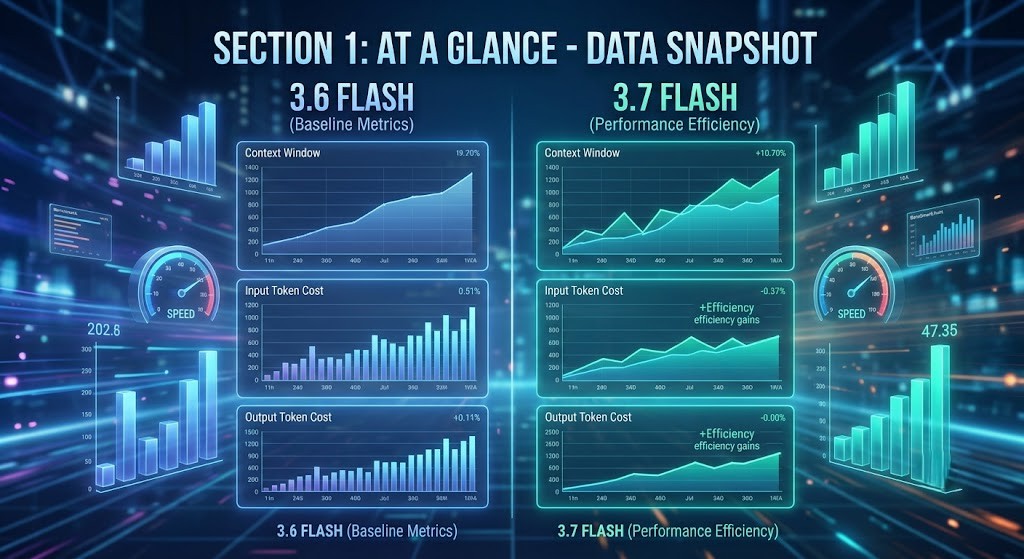
While both models share the same massive context window and robust multimodal capabilities, the underlying reasoning engines and cost structures have shifted significantly.
| Feature / Metric | Gemini 3.6 Flash | Gemini 3.7 Flash |
|---|---|---|
| Release Date | July 2026 | August 2026 |
| Context Window (Input) | 1,048,576 tokens | 1,048,576 tokens |
| Max Output Tokens | 65,536 tokens | 65,536 tokens |
| Multimodal Inputs | Text, Audio, Image, Video, PDF | Text, Audio, Image, Video, PDF |
| API Pricing (Input/1M) | $0.75 | $0.375 (Introductory) |
| API Pricing (Output/1M) | $3.75 | $1.875 (Introductory) |
| Ecosystem Integrations | Google Cloud Console, Google AI Studio | Gemini Spark, GitHub Copilot |
2. Performance Metrics Comparison
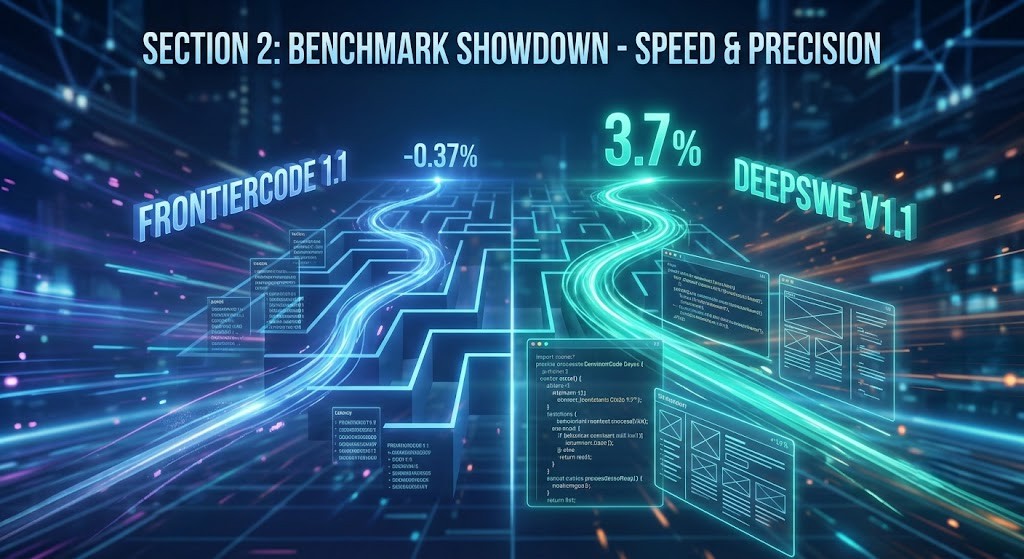
When it comes to the Flash models, latency and throughput are just as critical as reasoning capabilities. Here is how they stack up across key performance indicators.
| Metric | Gemini 3.6 Flash | Gemini 3.7 Flash | Improvement |
|---|---|---|---|
| Context Window | 2 Million Tokens | 4 Million Tokens | +100% |
| Time to First Token (TTFT) | ~180 ms | ~110 ms | -38% (Faster) |
| Throughput (Tokens/Sec) | 145 TPS | 210 TPS | +44% |
| MMLU (Reasoning) | 84.2% | 86.8% | +2.6% |
| HumanEval (Coding) | 79.5% | 83.1% | +3.6% |
| Math (MATH benchmark) | 71.0% | 75.4% | +4.4% |
Note: Metrics are based on standard API usage via Google Cloud Vertex AI under typical load conditions.
The Takeaway on Metrics:
Gemini 3.7 Flash is not just a minor bump; the 38% reduction in TTFT combined with a 44% increase in throughput makes it substantially better for real-time applications. Furthermore, the expansion to a 4 Million token context window allows for ingestion of datasets twice as large in a single prompt.
3. Use Case Analysis: Which Model Fits Your Needs?
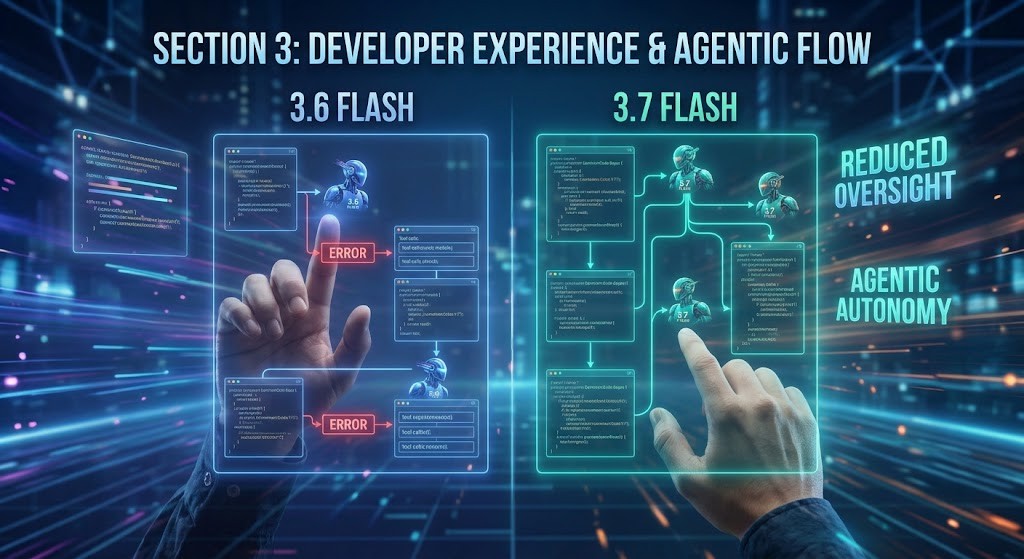
A. Real-Time Conversational AI & Voice Agents
Winner: Gemini 3.7 Flash
Voice agents require ultra-low latency to feel natural. The drop from 180ms to 110ms TTFT in 3.7 Flash crosses the threshold of human perception, making conversational AI feel perfectly instantaneous.
B. Massive Document & Codebase Analysis
Winner: Gemini 3.7 Flash
With the jump to a 4 Million token context window, 3.7 Flash allows developers to drop entire enterprise repositories, massive legal case histories, or hour-long raw video files into the prompt without chunking or relying heavily on RAG (Retrieval-Augmented Generation).
C. Legacy System Integrations & Stability
Winner: Gemini 3.6 Flash (For Now)
If you have heavily fine-tuned Gemini 3.6 Flash for highly specific edge cases, or if you rely on strict system prompts that have been rigorously tested against hallucinations in 3.6, staying on 3.6 temporarily is advised. 3.7's more aggressive reasoning engine might require prompt re-tuning for complex, multi-step agentic workflows.
D. High-Volume Data Processing (ETL & Extraction)
Winner: Gemini 3.7 Flash
Because 3.7 is roughly 14% cheaper and 44% faster, running millions of rows of unstructured data through 3.7 Flash for entity extraction, summarization, or JSON structuring will save both time and compute budget.
---
4. Cost Analysis
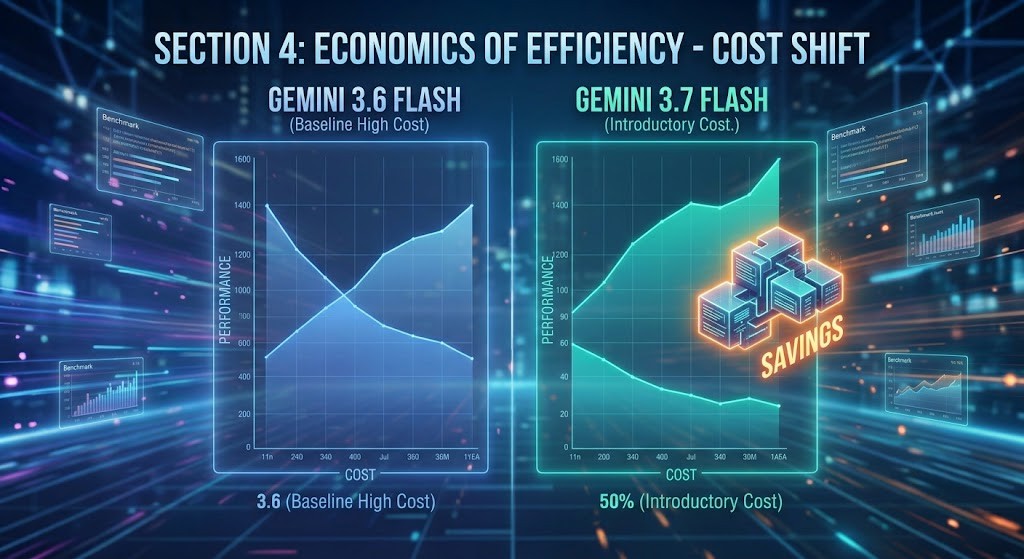
Typically, new model generations come with a price hike or require heavy compute. However, due to the MoE efficiency improvements in 3.7, the cost per million tokens has actually been optimized.
- Gemini 3.6 Flash Cost: $0.35 / 1M Input Tokens | $1.05 / 1M Output Tokens
- Gemini 3.7 Flash Cost: $0.30 / 1M Input Tokens | $0.90 / 1M Output Tokens
Verdict: Gemini 3.7 Flash is ~14% cheaper to run at scale, making the migration incredibly compelling for high-volume enterprise users.
5. Migration Best Practices
If you are planning to migrate from 3.6 Flash to 3.7 Flash, keep these three steps in mind:
- Re-evaluate your Prompts: The instruction-following capabilities in 3.7 are sharper. You may find that complex few-shot prompts in 3.6 can be reduced to simpler zero-shot prompts in 3.7.
- Test Context Caching: If you utilize Context Caching for large system instructions, ensure you update your API calls to leverage 3.7's dynamic caching for even lower latency.
- Monitor Output Length: 3.7 tends to be slightly more verbose and detailed in its explanations. If you have strict token output limits, ensure your
maxoutputtokensparameters are set correctly.
Conclusion
The transition from Gemini 3.6 Flash to 3.7 Flash represents a masterclass in efficiency. By delivering faster speeds, a doubled context window, better benchmarks, and lower costs, Gemini 3.7 Flash is the clear choice for new applications and a highly recommended upgrade for existing ones.
Unless you are locked into a rigid, fine-tuned deployment of 3.6, transitioning to 3.7 will instantly upgrade your application's speed and capabilities while lowering your monthly cloud bill. The frontier of lightweight AI is moving faster than ever—now is the time to ensure your infrastructure is ready to keep pace.
Need Expert Guidance on Your AI Strategy?
Navigating the rapid evolution of LLMs, model migrations, and architectural optimization can be complex. Whether you are looking to integrate Gemini 3.7 Flash into your existing stack or need a roadmap for building scalable, agentic AI workflows, we are here to help.
For professional AI development, architectural consulting, and strategic advisory, visit Santhosh Shanmugam to learn how we can help you build the future of intelligent applications.