The Evolution of Autonomy: How AI Agents Learn and Master New Skills
In the early days of AI, agents were rigid. They followed "if-then" logic, performing only the tasks they were explicitly programmed to do. Today, we are witnessing a paradigm shift: the rise of autonomous AI agents that don’t just follow instructions—they learn, adapt, and acquire new skills on the fly.
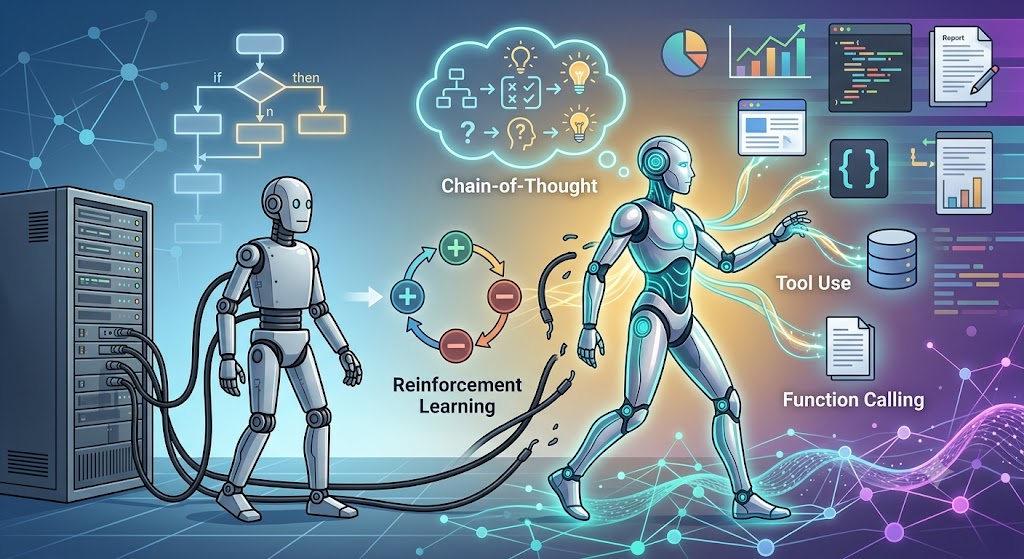
But how does an AI actually "learn" a new skill, and how does it apply that knowledge to real-world workflows?
1. The Mechanism of Self-Learning
Self-learning in AI agents is primarily driven by Reinforcement Learning (RL) and Iterative Feedback Loops.
- Trial and Error: Much like a human learning to ride a bike, an AI agent operates in an environment where it receives "rewards" for successful actions and "penalties" for failures. Over thousands of iterations, it optimizes its strategy to maximize the reward.
- Self-Correction: Modern agents utilize Large Language Models (LLMs) to perform "Chain-of-Thought" reasoning. If an agent fails a task, it can analyze its own logs, identify where the logic broke down, and adjust its approach for the next attempt.
- Active Learning: Advanced agents can identify gaps in their own knowledge. When faced with an unfamiliar task, they can trigger a search for documentation, query an API, or ask a human for clarification, effectively "studying" before executing.
2. How Agents Acquire Skills
Skill acquisition for an AI isn't about memorizing facts; it’s about procedural mastery. Agents acquire skills through three main avenues:
- Tool Use (Function Calling): An agent learns to use external tools (like a web browser, a Python interpreter, or a database) by understanding the API documentation. Once it learns the syntax, it can chain these tools together to solve complex problems.
- Few-Shot Prompting: By observing a few examples of a task, an agent can infer the underlying pattern and replicate it. This allows agents to learn new workflows without needing a software update.
- Knowledge Distillation: Agents can ingest vast amounts of unstructured data (PDFs, wikis, codebases) to build a "mental model" of a specific domain, effectively acquiring the skill of an expert in that field.
3. From Theory to Usage: The Practical Application
The true power of self-learning agents lies in their ability to bridge the gap between intent and execution.
- Dynamic Problem Solving: Instead of a static script, an agent can be given a high-level goal (e.g., "Research this market and draft a report"). The agent breaks this down into sub-tasks: searching, filtering, synthesizing, and formatting.
- Contextual Adaptation: If an agent is tasked with coding, it learns the specific style guide and architectural patterns of the existing codebase, ensuring its output is consistent with the team's standards.
- Continuous Improvement: Because these agents log their performance, they become more efficient over time. They learn which shortcuts work, which APIs are unreliable, and how to handle edge cases that weren't present in the initial prompt.
The Future: The "Always-On" Learner
We are moving toward a future where AI agents act as perpetual students. As they interact with the world, they accumulate a library of "learned behaviors."
The challenge for developers and users is no longer how to program the agent, but how to guide it. By providing clear objectives and high-quality feedback, we can help these agents evolve from simple assistants into highly skilled, autonomous partners.
Ready to Build Your Custom AI Agent?
The theoretical power of autonomous agents is incredible, but the real value lies in integrating them into your daily operations. If you are looking to develop custom, self-learning AI agents tailored to your specific business needs—whether that involves complex workflow automations, intelligent API integrations, or seamless full-stack applications—we can build them for you.
Let’s turn this cutting-edge technology into your competitive advantage. https://saandy.in to discuss how we can develop your custom AI workforce today.